

How AB 2097 Is Opening Access to New Locations, Cutting Costs, and Giving Restaurant Owners a Competitive Edge
There's a piece of California legislation most restaurant owners have never heard of — and it is a powerful tool for opening or expanding a food business in the state right now.
It's called Assembly Bill 2097, and since taking effect on January 1, 2023, it has quietly dismantled one of the biggest invisible barriers to opening a restaurant: mandatory parking requirements.
The Problem with Parking
Local zoning codes have long required restaurants to provide 8–15 parking spaces per 1,000 square feet — among the highest ratios of any commercial use. In urban areas like Los Angeles or San Francisco, a single structured parking space costs $25,000–$75,000 to build.
The result? Walkable, transit-adjacent neighborhoods were essentially locked out of restaurant development. A great retail space near a subway stop couldn't become a restaurant because the landlord couldn't conjure 20 parking spots on a dense urban block.
What AB 2097 Does
The law is elegantly simple: it prohibits cities from imposing minimum parking requirements on any development within half a mile of a major transit stop.
A "major transit stop" includes:
- Existing rail stations (Metro, BART, Caltrain, Metrolink)
- Ferry terminals served by bus or rail
- Intersections of two major bus routes with frequent service (≤20 min headways as of 2025's AB 2553 update)
This covers huge parts of California’s major cities. In Los Angeles alone, hundreds of business districts are now exempt from parking mandates.
Real Dollars Saved
Consider converting an 1,800 sq ft retail space into a restaurant in Studio City:
Before AB 2097: Local zoning required ~18 parking spaces. The developer needed $500K+ in land or $50K/year in shared parking leases. A 6–12 month parking study delayed permitting. The project never penciled out.
After AB 2097: Zero parking minimum. No study required. Permitting moves faster. The restaurant opens.
Industry consultants estimate the law cuts permit approval time by at least a third — translating into six-figure savings for a single transit-adjacent restaurant.
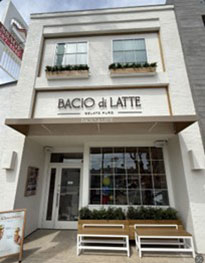
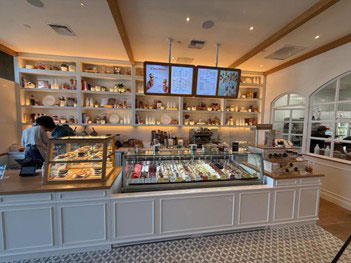
A Real-World Example: Bacio di Latte
Bacio di Latte in Studio City illustrates AB 2097’s impact. Previously, converting this retail spot to a restaurant would have required a parking study and impossible-to-find spaces. Under the new law, the developer added zero parking, turning a legally prohibited project previously into a high-traffic success.
Check Your Eligibility
- Locate Transit: Use Google Maps (Transit layer) to find rail or frequent bus stops nearby.
- Measure: Ensure the site is within a 0.5-mile radius using a digital radius tool.
- Confirm: Always verify with the city planning department before signing a lease.
Critical Limitations
- Mandatory: ADA-accessible parking and all health, safety, and building codes still apply.
- Excluded: The law does not cover hotels/motels or apply retroactively to existing permits.
- City Overrides: Cities can only reimpose parking minimums if they prove the waiver would "substantially harm" affordable housing or local parking supply—a high bar for restaurant projects.
Your Action Plan
- Scout transit corridors in your target market — Ventura Blvd, Sunset, Wilshire, Mission St, Market St
- Target underutilized retail or office spaces in walkable blocks near rail or rapid transit
- Negotiate your lease knowing you have no parking obligation — this is a real bargaining chip
- Recapture square footage that would have gone to parking for seating, kitchen, or outdoor dining
- Cite AB 2097 explicitly in your planning application to prevent back-and-forth on parking
The Bigger Picture
AB 2097 is part of a broader wave of California legislation supporting transit-oriented, walkable neighborhoods — exactly the kind that thriving restaurant districts require. Restaurant owners who position in these corridors now are riding a decade-long trend toward denser, less car-dependent California cities.
The Bacio di Latte story is a preview: a great concept, a great location, and a law that made an otherwise impossible project possible. That formula is repeatable — in Studio City, the Arts District, Oakland, San Jose, and San Diego.
Interested in exploring opportunities for your new build? Drop me an email.
Sources
- Legislative Sources
- Industry Benchmarks & Financials
Los Angeles Department of Building and Safety (LADBS) - Parking Regulations Summary.
UCLA Lewis Center for Regional Policy Studies - The High Cost of Parking